Chisel 
logo  Computer Human Interaction & Software 
Engineering Lab

Projects

CogZ

CogZ is a research project and tool. In the project, we are attempting to understand the cognitive support requirements needed in the area of human-guided ontology mapping. The tool is an implementation of these design requirements. Currently, CogZ exists as a Prompt user-interface plugin. Prompt is a mapping and ontology management plugin for Protégé.

Primary researcher: Sean Falconer

Partners: National Center for Biomedical Ontology (NCBO)

CreoleCreole

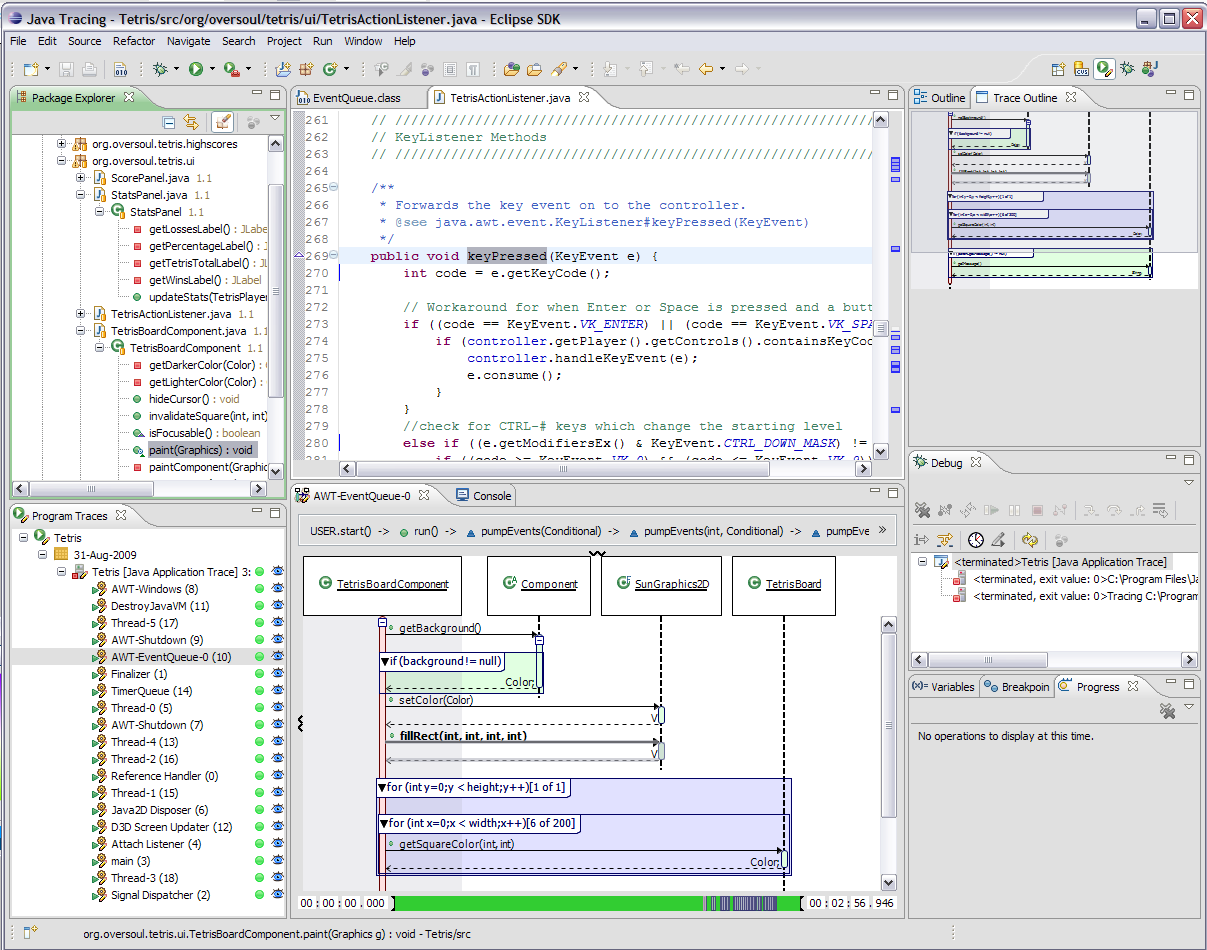
Creole is an Eclipse plug-in that uses SHriMP to allow you to explore your Java code visually. You can see your code's structure and the links (i.e. references, accesses, etc.) between its different pieces.

Primary developer: Chris Callendar

Partners: Consortium for Software Engineering (CSER)

CTeXplorer

CTeXplorer is a prototype for adaptive visualizations to gain insight from a collection of clinical trials for the prevention of Mother to Child transmission (MTCT) of Human Immunodeficiency Virus (HIV). The aim is to reduce the time medical researchers spend conducting literature reviews of related clinical trials and to ease the process of understanding data within clinical trials.

Primary researcher: Maria-Elena Hernandez

Partners: National Center for Biomedical Ontology (NCBO)

DiamondDIaMOND

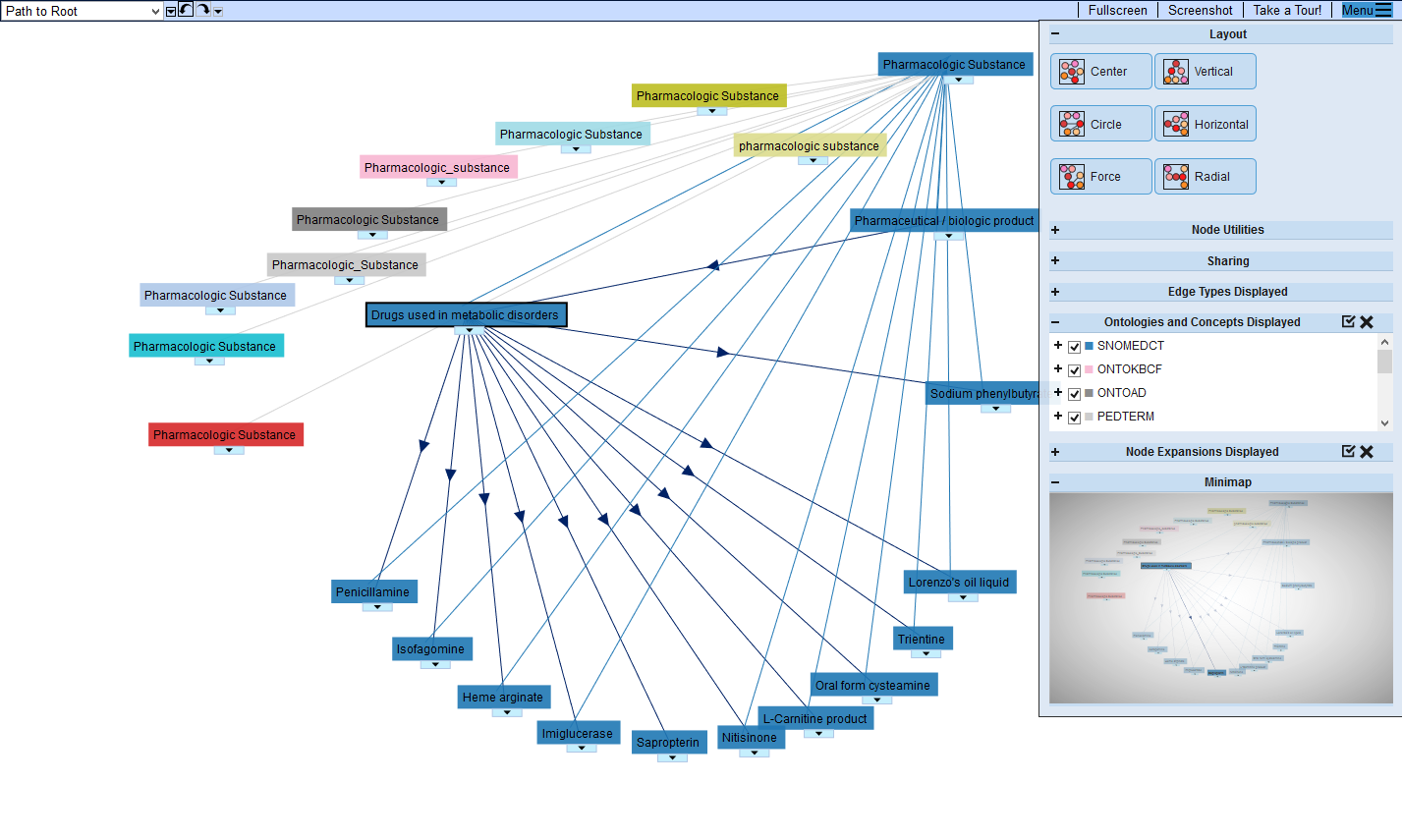
In the DIaMOND (Degree of Interest Modelling for Ontology Navigation and Development) project we are investigating the application of principles of attention-reactive interfaces to provide adaptive visualizations of ontologies.

Primary researcher: Tricia d'Entremont

Partners: National Center for Biomedical Ontology (NCBO)

DRDC Visualization

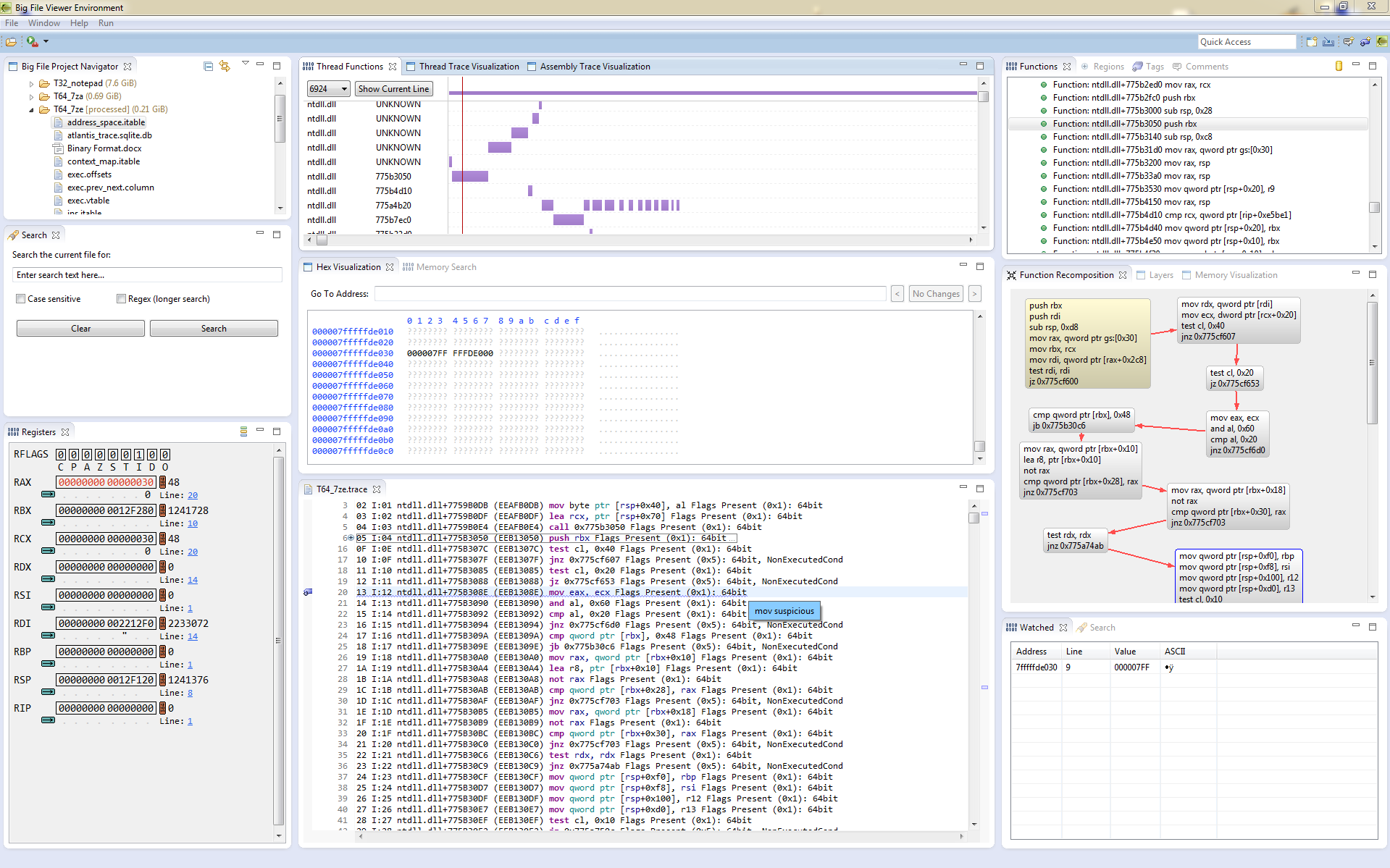
Under contract to Defence Research and Development Canada (DRDC) we are currently building on the SHriMP graph visualization framework and Zest layout packages to provide additional support for assembly language comprehension. This work includes diagrams for visualizing flow of control at the instruction/block level, sequence charts (as defined in UML), support for folding and unfolding portions of a graph (applicable to both sequence and control flow views), and enhancements to allow richer editing of node and edge attributes. A portion of this work will make its way into the normal SHriMP and Zest releases, with the rest being proprietary to this project.

Primary researchers: Chris Bennett & Del Myers

Partners: Defence Research and Development Canada (DRDC)

FATE

Feature Awareness Team Explorer (FATE) is a visualization tool for Jazz based software engineering repositories. It presents the relationships between engineering artifacts and contributors, revealing a broader issue context that enhances understanding of target artifacts.

Primary researcher: Lucas Panjer

JambalayaJambalaya

Jambalaya is a plug-in for Protégé that uses SHriMP to visualize ontologies. Protégé is "an ontology editor and a knowledge-base editor" developed at Stanford University, which allows domain experts to build knowledge-based systems by creating and modifying reusable ontologies and problem-solving methods.

Primary developer: Chris Callendar

Partners: Stanford University & the National Cancer Institute, U.S.

Model Driven Visualization

Model Driven Visualization (MDV) is an approach to generating visualizations using meta-models and model transformations. Using techniques prescribed by Model Driven Engineering, MDV supports rapid development of information visualization tools. Views created using the MDV framework can be seamlessly integrated with the Eclipse platform. While we are currently investigating the power of MDV in the Software Engineering domain, the applicability of this technology reaches deep into other fields.

Primary researcher: Ian Bull

Partners: IBM Centers for Advanced Studies

NCBONational Centre for Biomedical Ontology

The goal of the National Center for Biomedical Ontology (NCBO) is to support biomedical researchers by providing a web portal enabling them to access, review and integrate information in all aspects of biomedical investigation and clinical practice. The CHISEL group will be developing a framework to provide a set of visualization services for the web portal. We are also researching cognitive support for ontology alignment and repository searching.

PQViz

PQViz is a tool that has come out of our Jambalaya and CogZ research. The tool is available as a Protégé plugin and it provides a simple query interface for Protégé ontologies. Results are visualized as structural neighborhoods based on the ontology's relationships, which can be interactively explored. This tool is similar to Jambalaya's query tool interface, but uses different strategies for laying out and labeling nodes.

Primary researcher: Sean Falconer

Partners: National Center for Biomedical Ontology (NCBO)

Shrimp

SHriMP (Simple Hierarchical Multi-Perspective) is both an application and a technique designed for visualizing and exploring software architecture and any other information space.

Shrimp is a stand-alone application written in Java. It can open Protégé projects (.pprj), RSF projects (.prj and .rsf), GXL files (.gxl) and more. It also allows multiple projects to be open at once.

Primary developer: Chris Callendar

Software Peer Reviews

We are examining lightweight peer review techniques in both industrial and open source projects. We use a multi-case study methodology to discover the underlying parameters, structure, and policies involved in conducting software peer reviews.

Primary researcher: Peter Rigby

TagSEA

Tags for Software Engineering Activities (TagSEA) combines social tagging with the idea of geographical waypointing to offer a lightweight way to mark and navigate through points of interest in software engineering projects.

Primary researchers: Jody Ryall, Del Myers, and John Anvik

Partners: IBM Eclipse Innovation Grant & Natural Sciences and Engineering Research Council of Canada (NSERC)

ZestZest

Zest - The Eclipse Visualization Toolkit - is a set of visualization components built for Eclipse. The entire Zest library has been developed in SWT and integrates seamlessly within Eclipse. Zest has been modeled after JFace, and all the Zest views conform to the same standards and conventions as existing Eclipse views.

Primary researcher: Ian Bull

Partners: IBM Centers for Advanced Studies


Past Projects

Camarón

Camarón - Cognitive support in image management software.

Primary researcher: Tricia d'Entremont

Partners: ACD Systems

GILDGILD

GILD (Groupware-enabled Integrated Learning and Development) sought to address the shortage of tools providing pedagogical support for teaching and learning programming.

Researchers: Marilyn Burgess, Davor Cubranic, Daniela Damian, Daniel German, Elizabeth Hargreaves, Glen Kiessling, Jeff Michaud, Del Myers, Peter Rigby, Jody Ryall, Mary Sanseverino, Margaret-Anne Storey, Suzanne Thompson

Partners: Eclipse Innovation Grant Program and IBM

IDE Waypoint

IDEWaypoint is a plug-in tool that records annotated Eclipse state to support future navigation steps in Eclipse.

Primary researcher: Jie Zhang

Mode Confusion Concerns for Digital Cameras

The goal of this project was to develop a set of guidelines for creators of digital camera interfaces, focusing on specific design elements, to help reduce mode confusion potential in future designs. A secondary goal of this project was to develop a checklist to help end-users evaluate the interfaces of existing products on the market.

Primary researcher: Victor Chong

NavTracks

NavTracks was a plug-in that observed a developer's navigation patterns to provide a contextually relevant re-visitation system within Eclipse.

Primary researcher: Rob Elves

Partners: National Research Council

PromptViz

The PromptViz project explored ways to visualize ontology differences.

Primary researcher: Dave Perrin

SHriMP Views

An environment for information exploration Ebi: Integration of SHriMP with IBM's WebSphere Studio Application Developer Integration Edition (WSADIE).

Partners: IBM Centers for Advanced Studies

Sortie

Sortie: Re-engineering a modeling and simulation tool to support gradual program evolution and increased data visualization.

Primary researcher: Sachen Gendron

Usability of Distributed Learning Tools

Usability of Distributed Learning tools

Web-based Learning

Web-based Learning: Accessibility Issues for the Blind in a Virtual Classroom

Primary researcher: Shohreh Hadian

Youth as Nexus

Culture of Connectivity: Youth Experiences of ICT - Exploring the social and individual implications of technologically mediated interactions on young people.

Primary researcher: Mechthild Maczewski


Related Work

Eclipse is an open extensible IDE. The Eclipse Platform is designed for building integrated development environments (IDEs) that can be used to create applications as diverse as web sites, embedded Java programs, C++ programs and Enterprise JavaBeans.

Protégé is an open-source ontology editor and a knowledge-base editor written in Java. Protégé provides an extensible architecture for the creation of customized knoweldge-based applications.