Chisel 
logo  Computer Human Interaction & Software 
Engineering Lab
Shrimp Shrimp

Shrimp


Try It!

Try the Shrimp Demo...you have two choices:

  1. Java Webstart - Downloads and runs Shrimp automatically from your desktop...
  2. Java Applet - Runs Shrimp right in your browser...


Download

Shrimp can be downloaded from SourceForge.net Logo.


What Is It?

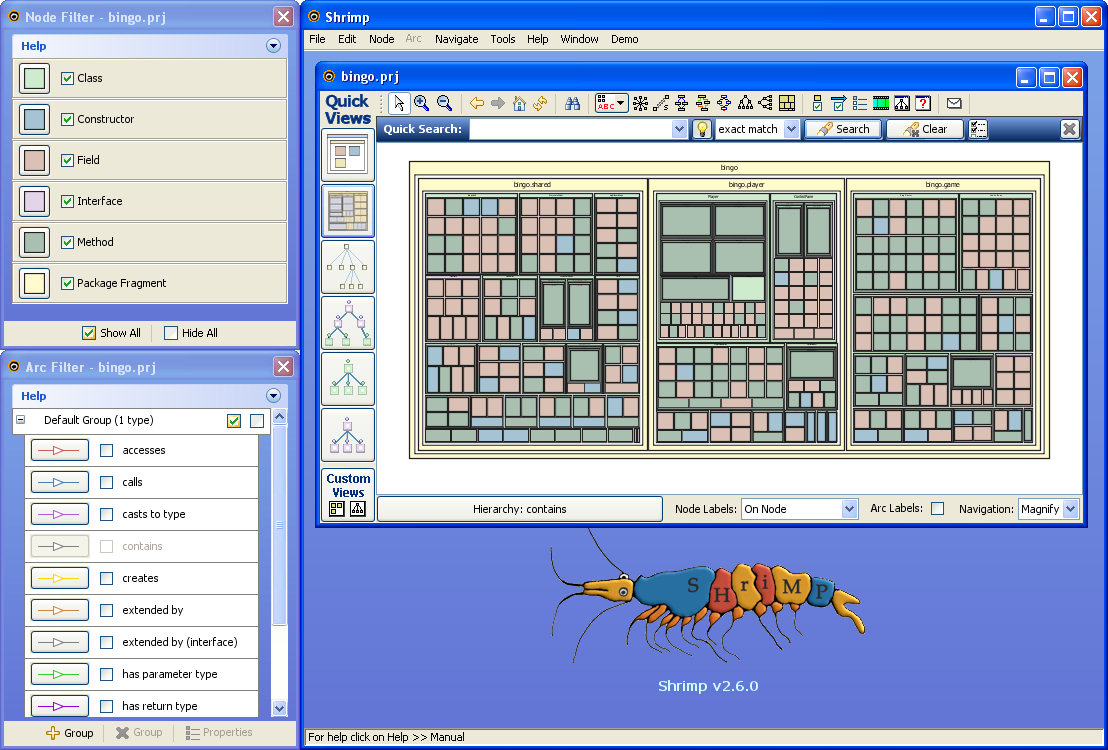
Shrimp is both an application and a technique, designed for visualizing and exploring software architecture and any other information space. SHriMP (Simple Hierarchical Multi-Perspective) is a domain-independent visualization technique designed to enhance how people browse and explore complex information spaces. Among the applications we are actively exploring is the exploration of large software programs, and the understanding of complex knowledge-bases (via the Protégé tool).


Shrimp Tool Suite

Shrimp currently has three main applications:

  • Jambalaya: A plug-in created for the Protégé tool, that uses Shrimp to visualize ontologies and knowledge bases the user has created. Protégé is "an ontology editor and a knowledge-base editor", developed at Stanford University, which allows domain experts to build knowledge-based systems by creating and modifying reusable ontologies and problem-solving methods.
  • Creole: An Eclipse plugin, uses Shrimp to allow you to explore your Java code visually. You can see your code's structure and the links (references, accesses, etc) between its different pieces.
  • Stand-Alone Shrimp: A stand-alone Java application that visualizes "graph based" data formats such as GXL, RSF, XML, XMI. (Stand-Alone Shrimp can also read Protégé knowledge-bases.)

Shrimp is brought to you by the CHISEL research group within the University of Victoria's Department of Computer Science. Research has been funded by NSERC, IBM, CSER, the University of Victoria, the British Columbia Advanced Systems Institute (BC ASI), and more recently by Stanford University.

Shrimp uses the Piccolo zooming library developed by the Human-Computer Interaction Lab (HCIL) at the University of Maryland.